Sun Power for Eloheh
Grandmother Sun and the Gift of Light
Long before anyone thought to capture her power in silicon panels, Grandmother Sun was already teaching us how to live. Our Indigenous ancestors understood something that the Western world is just now beginning to grasp: the sun is not merely an energy source to be exploited—she is a relative, a life-giver, a grandmother who has been sustaining all her children since the beginning of time.
In the traditional Keetoowah worldview, the fire in our hearths represents the sun, and both are honored as old women—grandmothers worthy of respect and gratitude. Our ancestors fed a portion of every meal to the fire, acknowledging her as family. When they faced the rising sun each morning in ceremony, dipping into the water seven times, they were greeting a relative and beginning the day in right relationship. We are, as the old ones taught, the Sun’s grandchildren.
This is what the dominant culture missed in their rush toward industrialization: you cannot have a healthy relationship with something you only see as a commodity. And yet, here we are—the earth warming, the climate destabilizing—finally forced to reckon with what Indigenous peoples have known all along. The sun has been offering us clean, abundant energy every single day. We just weren’t humble enough to receive it properly.
At Eloheh, we believe it’s time to honor Grandmother Sun in a new way—one that bridges ancient wisdom with appropriate technology—though not perfect—better than fossil fuels. Our solar array is not just about reducing our carbon footprint or lowering utility bills (though it accomplishes both). It’s about returning to a relationship of gratitude and reciprocity with the very source of all life on Earth.
The irony isn’t lost on us: Indigenous peoples were forced off their lands partly so that coal and oil could be extracted. Now we’re installing solar panels to help heal the damage that extraction caused. There’s a kind of justice in that—using the original power source, the one that was here all along, the one our grandmothers always trusted.
In Becoming Rooted, I wrote about the need to develop ceremonies of gratitude that connect us back to the land and sky. Our solar installation is, in its own way, a ceremony—a daily practice of receiving what Grandmother Sun freely offers, without taking more than we need, without the greater damage of poisoning the water or scarring the earth. Every kilowatt that flows through these panels is a small act of healing, a step back toward balance.
This is what regenerative living looks like: learning again how to be in good relationship with all our relatives, including the one who rises each morning to bless us with warmth and light. We hope this project inspires others to consider how they too might honor the ancient gifts that sustain us all.
—Randy Woodley, Eloheh Indigenous Center for Earth Justice
Agrivoltaics
In keeping with the mission of Eloheh as a sustainable teaching farm, the area underneath the solar array will be dedicated to growing selected crops that will thrive with partial shade.
Agrivoltaics is the term for multiple use of farm space for both photovoltaic generation of electrical energy and photosynthetic generation of crops (or sometimes grazing animals underneath).
Here’s what strikes us about agrivoltaics: it’s an approach that would have made perfect sense to our ancestors. Indigenous peoples never understood land as serving only one purpose. A forest provided food, medicine, building materials, ceremony space, and habitat for our animal relatives—all at once. The Western tendency to compartmentalize everything into single-use categories (this land is for farming, that land is for energy production) is a relatively recent and, frankly, impoverished way of thinking.
Agrivoltaics represents a quiet rebellion against that either/or mentality. The panels capture sunlight for electricity while the filtered light below creates ideal conditions for shade-tolerant crops like lettuce, kale, herbs, and berries. The plants benefit from protection against heat stress and reduced water evaporation. The panels benefit from the cooling effect of the vegetation below, which actually increases their efficiency. Everything works together.
This is what we mean when we talk about the Harmony Way—systems designed for mutual benefit rather than extraction. Grandmother Sun offers enough light for both purposes. We just had to be wise enough to share.
The Eloheh Solar Array
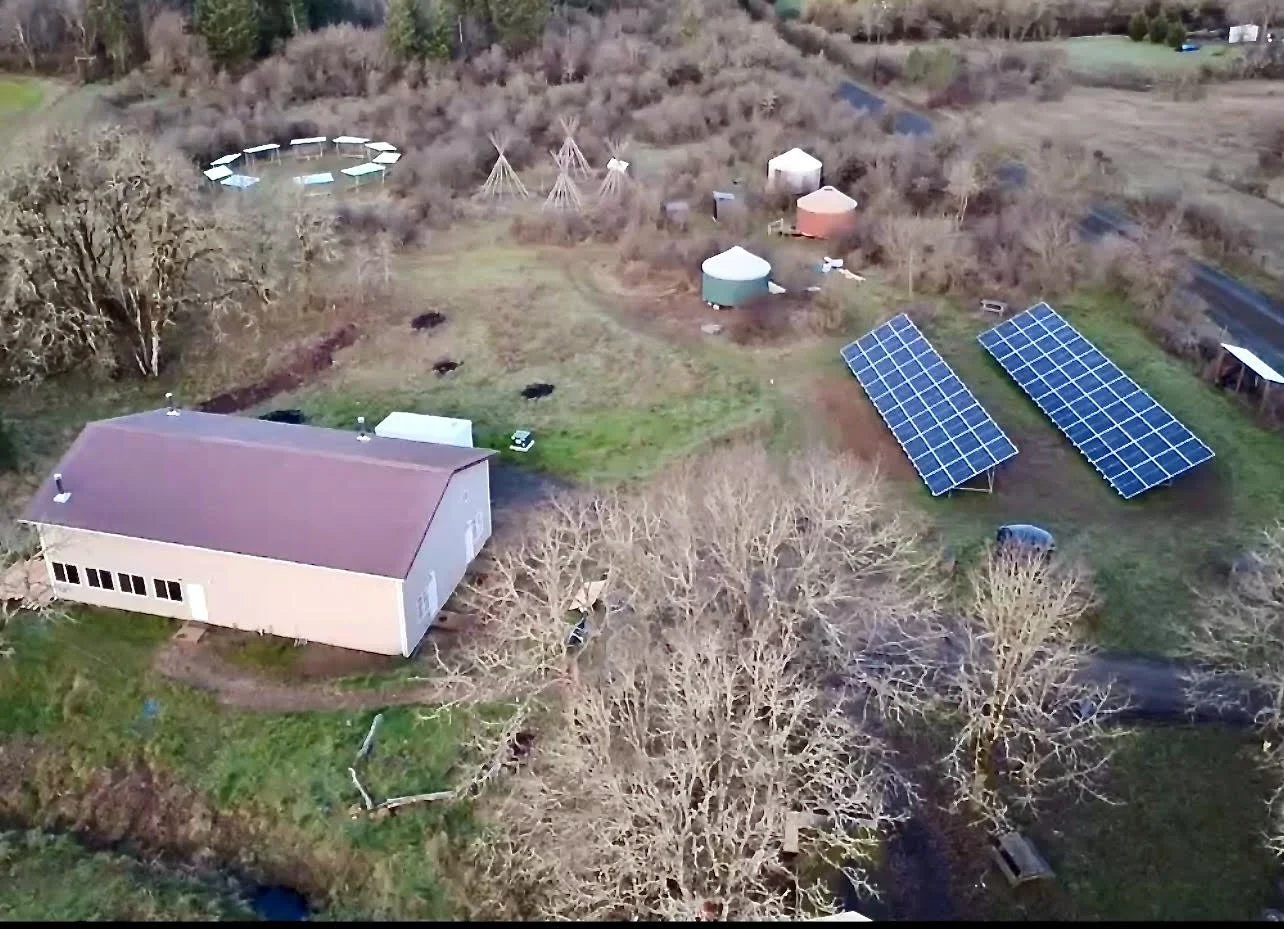
Two rows with a total of 84 panels provide a peak power of 40.74 kW. Panels are from SEG, produced in Texas by an American company. Each Yukon N panel operates up to 23% efficiency, producing up to 485 W each, and guaranteed for 30 years.
The total amount of power produced will be about 47,600 kWh every year, currently about the same amount Eloheh uses in one year and worth almost $10,000 at current rates.
Each solar panel has its own microinverter manufactured by Enphase. The IQ8P microinverters convert the DC output from each solar panel to usable AC. The combined outputs of the 84 microinverters are sent to a combiner panel IQ 6C that coordinates the energy conversion between all the microinverters and the storage batteries, also by Enphase.
The Eloheh Battery Storage System
The combined outputs of the 84 microinverters are sent to storage batteries, also by Enphase.
There are five pairs of IQ 10C batteries, each pair capable of storing 10 kWh of energy for off-grid use.
The total of 50 kWh of battery storage will allow the Eloheh Learning Center to serve as a community resource center in the event of a widespread power outage. Excess power produced will be returned to the grid and credited to Eloheh, providing power for the entire campus.
Grand Opening Celebration
Check back for photos of our grand opening celebration to be held later this spring.
The celebration will include information about Eloheh, agrivoltaics, solar energy, community solar, and ideas for how you can utilize or support solar energy or even join the solar workforce.
This installation has been constructed by Pinnacle Solar NW and funded by a grant from the PGE Renewable Development Fund as well as by funding from the Energy Trust of Oregon and bridge funding from the Oregon Community Foundation. Eloheh is grateful for their support.
This project has been made possible by customers participating in PGE’s Green Future℠ program through the PGE Renewable Development Fund.